

Getting care from a licensed doctor without leaving your home sounds simple until you realize that telehealth is not a borderless system. Every state has its own rules about which doctors can treat you virtually, and choosing the wrong provider can mean wasted money, voided prescriptions, or an invalid cannabis recommendation. This guide walks you through exactly what to prepare, how to search, and how to verify a telehealth doctor so your visit actually counts.
Table of Contents
- What you need before starting: eligibility and requirements
- Step-by-step guide to finding a telehealth doctor in your state
- Special cases: cannabis recommendations and behavioral health
- Troubleshooting common issues and ensuring legitimacy
- Why state-specific checks matter more than ever in telehealth
- Ready for your telehealth appointment? Here's how we can help
- Frequently asked questions
Key Takeaways
| Point | Details |
|---|---|
| Check state licensure | Always verify the telehealth doctor is licensed for your state before booking. |
| Use trusted platforms | Major networks and state-filtered directories simplify your search for qualified providers. |
| Watch cannabis rules | Telehealth cannabis recommendations require careful attention to both provider and state regulations. |
| Verify before paying | Avoid scams by confirming a provider’s eligibility and credentials before any payment. |
What you need before starting: eligibility and requirements
Before you open a single app or search engine, you need to understand why state licensure matters so much in telehealth. A doctor licensed in California cannot legally treat a patient who is physically located in Texas during the visit, even if that patient normally lives in California. The rule is based on where you are at the time of the appointment, not where you live on paper.
State telehealth laws and licensure outline a practical workflow: choose the care type you need, confirm the clinician is authorized for your specific state of residence, and verify any additional prescribing constraints that apply to your situation. Skipping any of these three steps is where most people run into problems.
Here is what you should have ready before you start searching:
- Valid government-issued ID (driver's license or passport) to confirm your state of residence
- Insurance card if you plan to use coverage, though many telehealth visits are cash pay
- A reliable device such as a smartphone, tablet, or laptop with a working camera and microphone
- Stable internet connection with at least 5 Mbps download speed for smooth video
- Your medical history summary including current medications, allergies, and any relevant diagnoses
- Age and residency confirmation since some platforms require you to be 18 or older and a resident of a supported state
Technology matters more than people expect. A dropped video call mid-consultation can delay your care or require a full rebooking. Test your camera and microphone before the appointment, close unnecessary browser tabs, and if possible, use a wired internet connection instead of Wi-Fi for better stability.
| Requirement | Why it matters | Where to find it |
|---|---|---|
| State-issued ID | Confirms your location for licensure purposes | Wallet or state DMV |
| Insurance info | Determines coverage and copay | Insurance card or app |
| Medical history | Helps doctor make accurate decisions | Personal records or prior provider |
| Working camera/mic | Required for video visits | Device settings test |
| Stable internet | Prevents call drops | Speed test at fast.com |
Doctor On Demand's clinicians page is a good example of how major platforms display state-specific access to licensed providers. Browsing it before you commit to a platform shows you exactly which states are covered and which are not.
Pro Tip: Before you spend time filling out intake forms, check that the platform or directory explicitly lists your state as supported. A "nationwide" label does not always mean all 50 states.
Step-by-step guide to finding a telehealth doctor in your state
Once you have your requirements ready, here is how to actually find a provider who is properly licensed and a good fit for your needs.
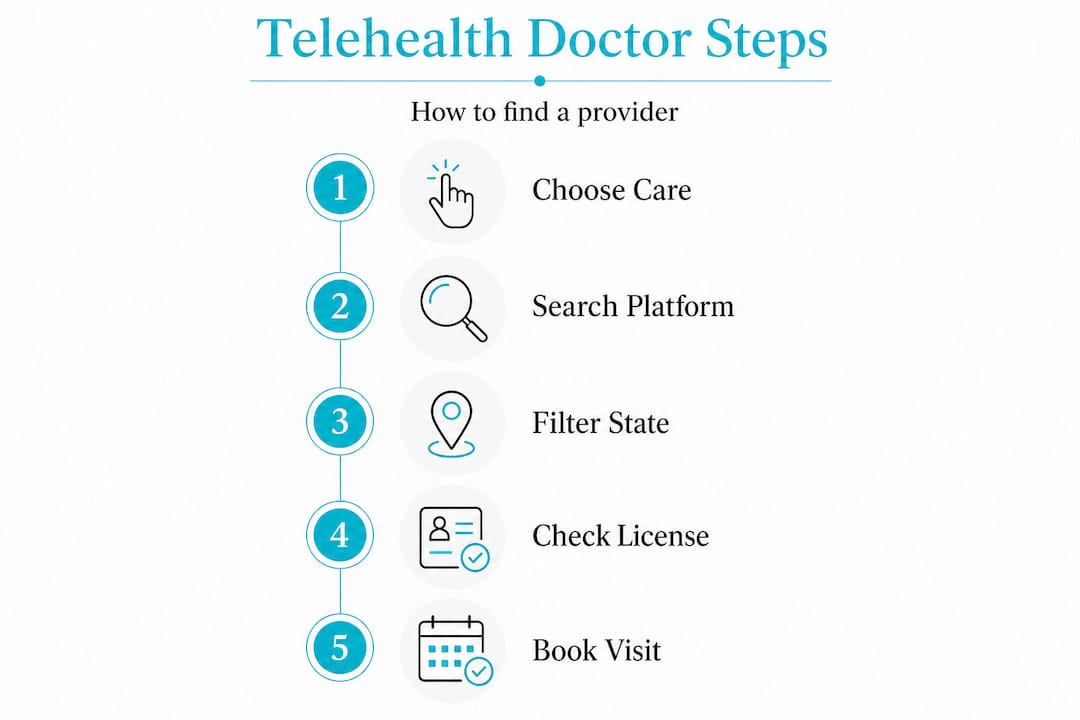
Step 1: Decide on your care type. General medicine, urgent care, dermatology, psychiatry, and cannabis recommendations all involve different types of providers and different regulatory rules. Knowing your care type narrows your search immediately and prevents you from wasting time on platforms that do not serve your specialty.
Step 2: Search reputable platforms that match your state. General telehealth networks cover a wide range of conditions and are often the fastest option. Specialty directories are better for mental health, cannabis, or chronic condition management. Start with the platform type that fits your need.
Step 3: Filter by your state. Every legitimate platform has a state filter or eligibility check. Use it. Do not assume that because a platform is popular, it covers your state for your specific care type. Some platforms cover general medicine in all 50 states but restrict psychiatric prescribing to only a handful.
Step 4: Compare provider credentials. Once you have a shortlist, look at each provider's profile. Check their medical degree, board certifications, years of experience, and patient reviews. A strong profile builds trust and helps you make an informed choice.
Step 5: Confirm state licensure before booking. This is the step most people skip. Look for a license number listed on the provider's profile, or ask the platform's support team to confirm the provider is authorized to practice in your state. Best telemedicine services reviews consistently note that the final check before paying should always be state authorization.
Step 6: Book and prepare. Once you have confirmed everything, schedule your appointment. Prepare a short list of questions or symptoms to share so you make the most of your time.
| Platform type | Best for | State filter available | Specialty depth |
|---|---|---|---|
| General telehealth network | Urgent care, primary care | Yes, usually at signup | Moderate |
| Specialty directory | Psychiatry, cannabis, therapy | Yes, with advanced filters | High |
| Hospital system telehealth | Chronic conditions, follow-ups | Based on health system coverage | High |
| Direct specialty app | Single condition focus | Varies by app | Very high |
For psychiatry and mental health specifically, the Psychology Today directory lets you filter by state and telehealth eligibility at the same time, which is one of the most efficient ways to find a licensed psychiatrist who can see you virtually.
Pro Tip: Before you schedule, read at least three recent patient reviews. Look specifically for comments about wait times, prescription follow-through, and whether the provider actually listened. These details matter as much as credentials.
Special cases: cannabis recommendations and behavioral health
Not all health needs are covered the same way, and two areas stand out for their added complexity: medical cannabis recommendations and behavioral health services.
Medical cannabis through telehealth is one of the fastest-growing use cases, but it is also one of the most legally variable. Some states fully allow telehealth evaluations for cannabis certification. Others require an in-person visit at least once before a telehealth follow-up is permitted. A few states do not allow telehealth cannabis evaluations at all.
Here is what to check before booking a cannabis telehealth visit:
- Does your state allow telehealth cannabis evaluations? This is a yes or no question. Look it up on your state's health department website or cannabis authority page before anything else.
- Is the provider licensed in your state AND authorized to issue cannabis certifications? These are two separate checks. A doctor can be licensed in your state without being registered with the state's cannabis program.
- What happens after the telehealth visit? In most states, completing the telehealth evaluation is only one step. You still need to register with the state program and pay any associated fees to receive your actual card.
"Some medical-cannabis telehealth platforms position themselves as helping patients complete state certification steps after a telemedicine visit, but you still must follow the state's registration requirements to obtain the actual card." Where's Weed guide
The distinction between a telehealth evaluation and the actual card is something many first-time applicants miss. The doctor's recommendation is not the card. It is the first step toward the card. Understanding this prevents frustration and delays.
When it comes to confirming cannabis telehealth rules, treat telehealth availability as a separate question from physician licensure. Confirm both that telehealth evaluations are allowed in your state and that the specific provider can legally issue a certification for your state's program.
Behavioral health follows a slightly different path. Psychiatrists, therapists, and counselors are often licensed state by state, just like physicians, but the directories available to find them are more robust. The Psychology Today directory lets you find behavioral health providers by filtering for your state, telehealth availability, insurance accepted, and specialty. This level of filtering makes it one of the most efficient tools for mental health searches.
One important note for behavioral health: controlled substance prescribing rules (such as for ADHD medications or anxiety medications) vary by state and by provider type. A therapist cannot prescribe. A psychiatrist can, but only if they hold the right license and DEA registration for your state.
Troubleshooting common issues and ensuring legitimacy
After you have chosen a provider, take these final steps to make sure your appointment goes smoothly and your care is legitimate.
Watch for hidden fees. Some platforms charge a membership fee on top of the visit cost. Others charge separately for the consultation and the prescription. Read the pricing page carefully before entering any payment information.
Never assume "nationwide" means all states. This is one of the most common and costly mistakes. A platform advertising nationwide coverage may exclude certain states for specific services. Always click through to the state eligibility page or call support to confirm.
Verify credentials independently when in doubt. Every state has a medical board website where you can look up a physician's license status. Search "[your state] medical board license lookup" and enter the doctor's name or license number. This takes about two minutes and gives you peace of mind.
Red flags to watch for before booking:
- No visible contact information or only a generic email form with no phone number
- Pressure to pay before confirming your state eligibility is a major warning sign
- Generic or templated website with no real provider photos, bios, or license numbers
- Promises that seem too easy such as "guaranteed approval" for cannabis cards, which no legitimate provider can offer
- No clear refund or cancellation policy if the visit cannot proceed due to eligibility issues
Doctor On Demand's clinicians page is a useful benchmark for what a legitimate platform looks like. Each provider has a full bio, credentials, and state availability listed clearly.
Pro Tip: Before you complete payment, double-check that your booking confirmation email or screen lists your state correctly. If it does not match your current location, contact support immediately before the appointment.
Why state-specific checks matter more than ever in telehealth
Here is a perspective most telehealth guides skip over: the assumption that telehealth equals borderless care is one of the most expensive myths in digital health right now.

People hear "virtual visit" and imagine a system as flexible as streaming a movie. You can watch Netflix from any state. You cannot legally see a doctor from any state unless that doctor is licensed where you physically are. The telehealth licensure framework has not caught up to the borderless internet, and it may not for years.
The practical cost of ignoring this is real. Patients have paid for cannabis evaluations only to discover the provider was not authorized in their state, making the recommendation invalid. Others have received prescriptions that pharmacies refused to fill because the prescribing doctor lacked the proper state registration. These are not edge cases. They happen regularly, and they are almost always avoidable.
What we find most interesting is that the patients most likely to skip verification are often the most motivated ones. They are eager to get care quickly, which is completely understandable. But rushing the state-check step is like skipping the ID check at the airport. The rest of the process does not work without it.
The telehealth landscape is also changing quickly. Several states have updated their laws since 2020, and what was allowed during pandemic emergency orders may no longer apply. Checking current rules, not rules from a blog post written two years ago, is the only way to stay accurate.
Being meticulous about state-specific verification does not slow you down in any meaningful way. It takes about five extra minutes. What it prevents is wasted money, invalid care, and the frustration of starting the whole process over from scratch.
Ready for your telehealth appointment? Here's how we can help
You now have a clear picture of what to prepare, how to search, and what to verify before your virtual visit. That knowledge puts you ahead of most people navigating telehealth for the first time.
JiffyDoctor connects patients with state-licensed providers for a range of needs, including medical cannabis recommendations, general consultations, and more. The platform is built around the exact steps you just learned: state-specific provider matching, transparent credentials, and a streamlined booking process that does not waste your time. If you are ready to move from research to action, JiffyDoctor is designed to make that next step as fast and straightforward as possible.
Frequently asked questions
How do I confirm if a telehealth doctor is licensed for my state?
Check the provider's profile for a listed state license number, or search your state medical board's website using the doctor's name. The National Telehealth Authority recommends confirming state authorization as a required step before booking any telehealth visit.
Can I get a medical cannabis card through telehealth everywhere?
No. Each state sets its own rules about whether telehealth evaluations qualify for cannabis certification. Always confirm your state allows it before paying for a visit, as the Where's Weed guide notes that completing a telehealth visit is only part of the process.
What steps should I take if my state is not listed on a telehealth platform?
Use a specialty directory that allows state-level filtering, or contact your state health department for a list of approved telehealth resources. Doctor On Demand's clinicians page is one example of a platform that shows state-specific availability clearly.
Are telehealth visits covered by insurance?
Coverage varies significantly depending on your insurer, your plan type, and the platform you use. Always check with your insurance provider and confirm with the telehealth platform before booking to avoid unexpected out-of-pocket costs.