

Getting a medical cannabis card sounds straightforward until you actually start the process. Many applicants assume it works like getting a note from their doctor for a gym excuse or a sick day. The reality is far more demanding: a valid doctor's signature on a state-specific certification document is a legal requirement in nearly every medical cannabis program across the country. Get the paperwork wrong, use the wrong provider, or skip a required step, and your application will be denied. This guide explains exactly why that signature matters, what it legally represents, and how to avoid the mistakes that trip up thousands of applicants every year.
Table of Contents
- What does a doctor's signature on a cannabis card mean?
- Legal reasons for requiring a doctor's signature
- Why a doctor's signature acts as a safeguard
- How the process differs from a standard prescription
- Most people overlook these cannabis card signature realities
- Get started easily with professional cannabis card help
- Frequently asked questions
Key Takeaways
| Point | Details |
|---|---|
| Formal certification required | A proper cannabis card needs an official provider certification, not just a casual note. |
| Legal compliance is key | State programs mandate specific signatures to ensure legality and registry inclusion. |
| Provider eligibility varies | Only authorized and trained providers approved by the state can sign your certification. |
| Mistakes cause delays | Missing signatures or incorrect forms are major reasons for application denial. |
What does a doctor's signature on a cannabis card mean?
Most people picture a doctor's note as a simple piece of paper with a signature at the bottom. A cannabis card certification is nothing like that. It is a formal, legally binding document that confirms a patient has a qualifying medical condition and that a licensed, state-registered provider has reviewed their case and determined that medical cannabis is appropriate.
In U.S. state medical cannabis programs, the doctor's written recommendation or certification is the gateway document that connects you to the state registry. Without it, there is no card. Without a card, there is no legal protection for possession or purchase. That chain of authorization starts and ends with a valid, properly executed signature.
Here is a clear breakdown of how a standard doctor's note compares to the formal state cannabis certification:
| Feature | Doctor's note | State cannabis certification |
|---|---|---|
| Legal standing | Informal, not state-recognized | Legally recognized by state registry |
| Provider requirements | Any licensed doctor | State-registered, eligible provider only |
| Medical record review | Optional | Typically required |
| Linked to state registry | No | Yes, directly |
| Accepted for cannabis purchase | No | Yes, at licensed dispensaries |
| Expiration | None set | Usually 1 year, requires renewal |
| Document format | No standard format | State-specific, often tamper-resistant |
The certification process typically includes several steps before a signature is ever placed on that document:
- A review of your existing medical records to confirm a qualifying diagnosis
- A physical or telehealth consultation to assess your current condition
- A discussion of your treatment history and why cannabis may be appropriate
- Confirmation that your condition appears on the state's approved qualifying conditions list
- The provider's formal written certification, signed and submitted to the state
"The doctor's signature on a cannabis certification is not just a formality. It is a legal attestation that a qualified provider has evaluated you, confirmed your qualifying condition, and authorized your participation in the state program."
The signature also carries weight for the provider. Signing a cannabis certification ties that provider's license to your case. That accountability is exactly why the process is more involved than a routine office visit.
Legal reasons for requiring a doctor's signature
Understanding what a valid doctor's signature represents sets up why states demand strict requirements. Here is the legal backbone behind it.
States built their medical cannabis programs around one core challenge: how do you allow legal access to a federally controlled substance without creating a system that is easily abused? The answer was to make the certification process as rigorous as a controlled substance authorization. The "doctor signature" requirement is largely a compliance mechanism that helps ensure the recommendation is tied to a qualifying condition and issued by a provider authorized under that state's rules.
Here is how the legal compliance structure works, step by step:
- Qualifying condition verification. The provider must confirm that your diagnosis appears on the state's approved list. Chronic pain, PTSD, cancer, epilepsy, and multiple sclerosis are common examples, but each state's list is different.
- Provider eligibility check. Not every licensed doctor can sign. States maintain registries of approved certifying providers. Some states also allow nurse practitioners and physician assistants to certify, but only if they meet specific training and registration requirements.
- Registry linkage. Once signed, the certification is submitted to the state's patient registry. This links your name, your condition, and your provider's credentials in a single verifiable record.
- Audit trail creation. The signature and authorization creates a verifiable audit trail for registry entry and prevents tampering or use of non-original documentation. If a question ever arises about your card's validity, the state can trace it back to the original signed document.
- Fraud prevention. The system makes it significantly harder to fabricate or alter certifications because the document must match registry records tied to a real, registered provider.
States have also built in consequences for providers who sign certifications carelessly or fraudulently. A provider who certifies patients without proper evaluation risks losing their medical license, not just their ability to certify cannabis patients.
Pro Tip: Before your appointment, request your medical records from your primary care doctor and bring them to your certification consultation. Providers who can review documented history move through the process faster and are less likely to request additional visits before signing.
One detail that surprises many applicants: the state often sets a minimum standard for how the certification must be formatted. Some states require tamper-resistant paper. Others require specific language in the provider's statement. A certification that looks legitimate but uses the wrong form can still be rejected by the registry.
Why a doctor's signature acts as a safeguard
Now that you know why strict rules exist, here is how the signature functions as a safeguard for everyone involved, not just the state.
The certification system creates a layer of protection that benefits patients, providers, and the public. For patients, it means the person signing your certification has met a minimum standard of training and is accountable to the state. For providers, it means they operate within a defined legal framework that protects them from liability when they follow the rules correctly.

The signature requirement is also risk management for the clinician and patient. States limit who can certify and often require training or registration as a condition of participation. This is not bureaucratic red tape. It is a meaningful filter that keeps unqualified or careless providers out of the system.
Here is what the safeguard system actually prevents:
- Fraudulent certifications from providers who are not registered with the state program
- Certifications based on unverified diagnoses that do not meet the qualifying condition standard
- Out-of-state certifications being used in states where the provider has no registration
- Copied or altered documents that attempt to replicate a legitimate certification
- Expired certifications being submitted as valid for renewal or new card issuance
"Treat your signed cannabis certification the way you would treat a government-issued ID. Keep the original, know its expiration date, and start the renewal process at least 60 days before it expires."
Missing or invalid signatures are one of the leading causes of application denial. This is not a minor administrative issue. If your certification is rejected, you have to restart the process, which means another consultation, another fee, and another waiting period before your card is issued.
Pro Tip: After your consultation, ask your provider to confirm that they are currently registered with your state's medical cannabis program. Provider registrations can lapse, and a certification signed by a lapsed provider will be invalid even if everything else is correct.
States also require providers to complete continuing education or specific training on cannabis medicine before they can certify patients. This requirement exists because medical cannabis involves real clinical decisions, including dosing considerations, drug interactions, and contraindications with existing medications. A provider who has completed the required training is better equipped to make those decisions responsibly.
How the process differs from a standard prescription
Finally, let us clarify one of the biggest sources of confusion: how a cannabis card certification differs from a regular prescription.
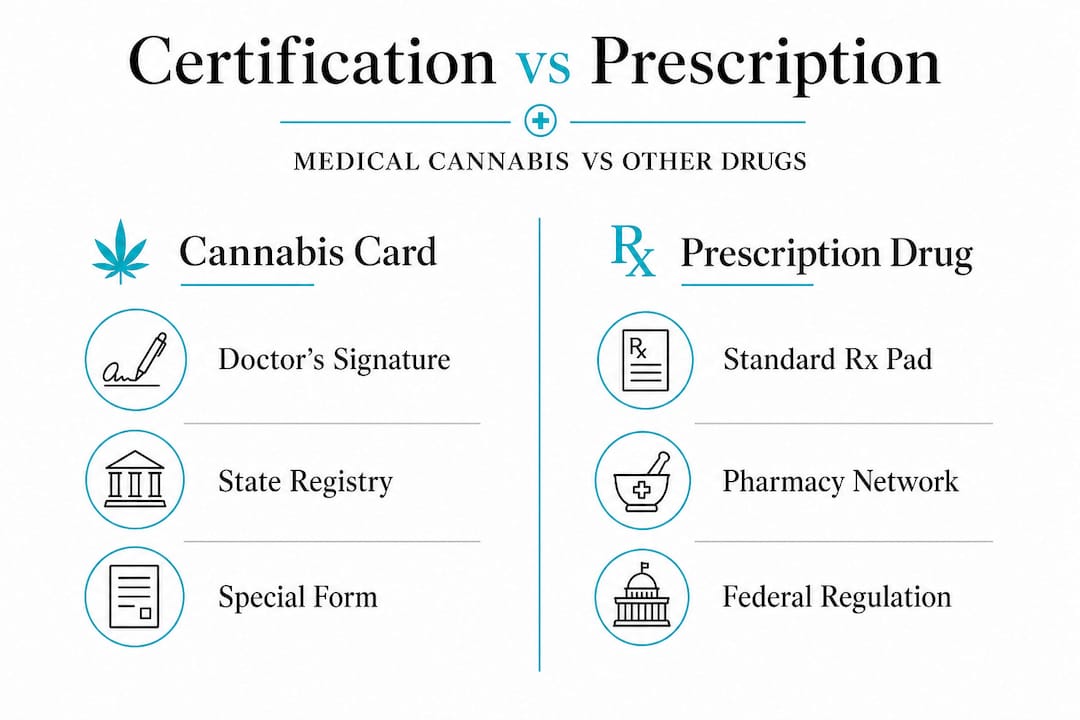
When your doctor prescribes blood pressure medication, that prescription travels through a federally regulated system. The DEA tracks controlled substances. Pharmacies verify prescriptions against federal databases. The entire framework is built on federal law. Cannabis does not fit into that system at all.
Clinicians do not "prescribe" cannabis through the normal federal prescription framework because cannabis remains a Schedule I controlled substance under federal law. Instead, state programs use state-law certifications and recommendations tied to state regulation and the patient registry and card system. This distinction matters enormously for how you think about the process.
Here is how the two systems differ in practice:
- Federal vs. state authority. A standard prescription carries federal legal weight. A cannabis certification is only valid within the state that issued it and has no federal recognition.
- No DEA involvement. Cannabis certifications are not reported to or tracked by the DEA. They exist entirely within state-managed databases.
- No pharmacy dispensing. You cannot take a cannabis certification to a regular pharmacy. It only authorizes purchases at state-licensed dispensaries.
- Renewal cycles. Standard prescriptions can often be refilled multiple times over a year. Cannabis certifications typically expire after 12 months and require a new evaluation and signature to renew.
- No generic substitutions. A pharmacist can substitute a generic drug for a brand-name prescription. There is no equivalent system for cannabis products. Your certification authorizes access, not a specific product.
"Many applicants use the word 'prescription' when they mean 'certification.' Using the wrong terminology can actually signal to a provider that you do not understand the legal framework, which may affect how they approach your consultation."
Understanding this distinction also helps you avoid a common scam. Some services advertise that they can provide a "cannabis prescription" valid in all states. This is not possible. There is no such thing as a nationally recognized cannabis prescription. Any service making that claim is misleading you.
Most people overlook these cannabis card signature realities
Stepping back, what do most people actually miss about this process? Here is the bottom line from practical experience.
The single biggest oversight is assuming that any licensed doctor can certify you. Many applicants book appointments with their regular physician, only to find out that their doctor is not registered with the state cannabis program and legally cannot sign the certification. This wastes time and money and delays access to care.
Edge cases create problems more often than most people realize. Using a photocopy of your certification instead of the original, sourcing a certification from a provider licensed in a different state, or skipping the medical record review step are all common errors that lead to denial. These are not obscure technicalities. They are the exact requirements the state registry checks before issuing a card.
Another reality that catches people off guard is the renewal process. Many applicants treat their first certification as a one-time hurdle and then scramble when their card expires. Most states require a full re-evaluation, not just a quick check-in, for renewals. If your provider's registration has lapsed in the meantime, you need to find a new certified provider and start over.
Form requirements also create unexpected bottlenecks. Some states mandate that the certification be printed on tamper-resistant paper with specific security features. Others require the provider to include particular language about the patient's condition and treatment history. A document that is signed correctly but formatted incorrectly will still be rejected. Checking your state's current form requirements before your appointment is a step most applicants skip entirely.
The bottom line is this: treat the signed certification as a legal document, because that is exactly what it is. Keep the original in a safe place, note the expiration date the day you receive it, and verify your provider's current registration status before every appointment.
Get started easily with professional cannabis card help
Getting the right certification the first time saves you from delays, extra fees, and the frustration of starting over. The documentation requirements are real, and working with a provider who knows your state's specific rules makes a measurable difference in how smoothly your application moves through the registry.
JiffyDoctor connects you with licensed, state-registered providers who specialize in medical cannabis card certification through convenient telehealth appointments. No waiting rooms, no scheduling delays, and no uncertainty about whether your provider meets your state's requirements. The platform also supports renewals, so when your certification approaches its expiration date, you can get re-evaluated quickly and keep your access uninterrupted. If you are ready to move forward with confidence, JiffyDoctor makes the process straightforward from start to finish.
Frequently asked questions
Who is authorized to sign a medical cannabis certification?
Only state-registered and eligible providers can sign. The authorized signer could be an MD, DO, or other clinician such as a nurse practitioner or physician assistant, depending on state statute and program rules.
Why isn't a doctor's note or a standard prescription enough for a cannabis card?
Because cannabis remains a Schedule I controlled substance under federal law, states require a special signed certification tied to their registry system, not a regular prescription or informal note.
What are the most common mistakes when submitting cannabis card paperwork?
Submitting copies instead of originals, missing signatures, or using the wrong document format are the leading causes of application denials and processing delays.
Does each state have the same requirements for the doctor's signature?
No. Each state sets its own processes, forms, and eligible signers. The exact legal mechanics vary significantly, though some form of signed authorization is required for registry entry in every state with a medical cannabis program.